For the first time ever, we are going to make our very own globe. I predict it will be a useful tool to illustrate the world God made for us as we learn about creation. As we talk about different aspects of creation, we will add to the globe.
Here it is in its beginning phase:
Visit this blog to see the wonderful ways the children in the Bunny Rabbit class at School for Little Children LEARN THROUGH PLAY!
Tuesday, September 30, 2014
Wednesday, September 24, 2014
Fingerpainting
We fingerpainted for the first time in Bunny class. Not everyone was excited about getting paint on their hands, but these girls had no reservations about it.
One of them said, "Look, Mrs. O'Connor! It looks like red nail polish!" Indeed it did, and then all three of them proceeded to "polish" their nails by rubbing red paint on each fingernail one by one. They were so delighted, and it was reallllly cute!
Monday, September 22, 2014
Introducing Games
We have jumped right in with introducing the children to playing games. In Bunny class, our games have no winner and no loser. We just play to a natural end. The game pictured above is called Honey Bee Tree. The tree is filled with leaves on long stems and tiny bees. As the children take turns to carefully pull out the leaves, the bees begin to fall out of the tree. When all the bees are out, the game is over and we start again. The purpose of games at this age and stage of development is simply to understand turn taking in order, one at a time. Once that skill is mastered (and it will take a while!), we can move on to some rules of play.
Play games at home! It's fun and good for the brain.
Wednesday, September 17, 2014
Light Science Experiment
We did a neat science experiment to explore the properties of light.
Each Bunny got a sheet of photo sensitive paper and could put four objects on it. We took them outside and placed them in the bright sum for about 5 minutes. When we brought them in, they looked like the photo below. Each item had left a shadow and the surrounding paper was very pale blue.
Each child removed the objects and immersed the paper in water to develop it.
In the following few minutes, the paper turned dark blue and the places where the objects had been stayed light.
Exactly how and why the paper changed was a bit beyond their understanding, but the main point was that God gave us light and light can change things in our world. Everybody could clearly see change happening on their paper. Science can be very exciting at the preschool level!
Each Bunny got a sheet of photo sensitive paper and could put four objects on it. We took them outside and placed them in the bright sum for about 5 minutes. When we brought them in, they looked like the photo below. Each item had left a shadow and the surrounding paper was very pale blue.
Each child removed the objects and immersed the paper in water to develop it.
In the following few minutes, the paper turned dark blue and the places where the objects had been stayed light.
Exactly how and why the paper changed was a bit beyond their understanding, but the main point was that God gave us light and light can change things in our world. Everybody could clearly see change happening on their paper. Science can be very exciting at the preschool level!
Monday, September 1, 2014
Off to a Good Start!
Our first two days of Bunny Rabbit class are off to a good start. The children had plenty of things to do in the room to help them begin to make new friendships or renew some old ones.
We had a Back-to-School party set up in our dramatic play area. There were party hats, party dishes, an ice cream play set and a cake play set.
There was even a teeny tiny present. The Bunnies were enthused to guess what was inside it and giggled when they realized the box was empty. A joke!
Having simple props that represent real activities provide a way to get kids talking to each other.
Meanwhile in other parts of the room, there were simple activities that every child could be successful in attempting.
Just look at those little fingers working so hard!
Playdough is a crowd pleaser and we will have it out almost every day of the entire year.
Please check back here often to see the wonderful learning that goes on in the Bunny Rabbit class.
We had a Back-to-School party set up in our dramatic play area. There were party hats, party dishes, an ice cream play set and a cake play set.
There was even a teeny tiny present. The Bunnies were enthused to guess what was inside it and giggled when they realized the box was empty. A joke!
Having simple props that represent real activities provide a way to get kids talking to each other.
Meanwhile in other parts of the room, there were simple activities that every child could be successful in attempting.
Just look at those little fingers working so hard!
Playdough is a crowd pleaser and we will have it out almost every day of the entire year.
Please check back here often to see the wonderful learning that goes on in the Bunny Rabbit class.
Tuesday, May 13, 2014
Outdoor Day
What a great tradition! Outdoor Day is always a fun day. It's messy and wet and busy and the children absolutely love it!
Mrs. O'Connor and Mrs. Quinn have had a wonderful year growing in God's grace with these sweet Bunnies! We will miss you and your cutie smiles!
Monday, May 5, 2014
The Three Little Pigs
This group of Bunnies has really taken a liking to acting out stories using props. We did some literary comparing and contrasting of different versions of the Three Little Pigs one day. It's a familiar story to most children so it's a great candidate to get the children making some higher level evaluations and predictions.
The next day I brought in some story props and put them in the book area without any fanfare. To our delight, the children noticed right away and began using the props to act out the story.
One child held the book and retold the story while the others wore the props and acted out the story. Then, without any adult coaching (!) they traded around the props and did it all again in different roles. Amazing! It was fun to watch and such a wonderful reflection of how much the children have grown this year. This level of collaboration and cooperation is the result of strong friendships, mutual respect and a good sense of how to have fun!!
The next day I brought in some story props and put them in the book area without any fanfare. To our delight, the children noticed right away and began using the props to act out the story.
One child held the book and retold the story while the others wore the props and acted out the story. Then, without any adult coaching (!) they traded around the props and did it all again in different roles. Amazing! It was fun to watch and such a wonderful reflection of how much the children have grown this year. This level of collaboration and cooperation is the result of strong friendships, mutual respect and a good sense of how to have fun!!
Tuesday, April 29, 2014
The Power of Playdough
Playdough is one of the very best materials in an early childhood classroom. In the Bunny Rabbit class we have it available almost every single day, and children flock to it.
Playdough is a very forgiving substance so it's a great medium for practicing and refining motor skills such cutting with scissors.
It is also a great catalyst for social interaction. Children can work side by side and natural curiosity gets them taking about what they are making.
Playdough is very easy to make at home and homemade playdough lasts much longer than store-bought playdough AND if you make it at home you can even scent it with cinnamon or vanilla or coffee or spices. Ask me for our SLC recipe if you want to give it a go at home.
Playdough allows little hands to squeeze, manipulate, press, pinch, roll and pull which develops hand strength and fine motor control.
It is also a great catalyst for social interaction. Children can work side by side and natural curiosity gets them taking about what they are making.
Playdough is very easy to make at home and homemade playdough lasts much longer than store-bought playdough AND if you make it at home you can even scent it with cinnamon or vanilla or coffee or spices. Ask me for our SLC recipe if you want to give it a go at home.
Tuesday, April 22, 2014
Bread Bread Bread
We stretched our learning of the Little Red Hen to learning about breads around the world. There is a book called Bread Bread Bread by Ann Morris which depicts bread in many cultures around the world, and it was the jumping off place for this kind of learning.
Mrs. Quinn and the Bunnies made pancakes (multiple batches!).
Everybody loved them!
We had a two person game called Cookin' Cookies in which the players try to collect the ingredients on their recipe cards and we also had a memory game for matching a variety of breads such as baguette, bagel, naan, etc.
There was a game for matching muffin tops with different amounts of blueberries to their corresponding muffin cup.
We had a pizza fraction game on the floor. Aren't fractions too advanced for preschoolers? NOPE! They can easily compare size and determine if a certain sized slice will fit in their pizza or not.
As a literacy activity the children made their own playdough baked goods and dictated a description of them.
We also had a taste test with three types of bread - naan, challah and corn tortillas. The children bravely tried them all and then we graphed the results. In dramatic play, the children acted out the story of Jesus feeding his followers with loaves and fish.
Over the course of a few days, we infused bread into every activity and every domain of the curriculum. The Bunnies had so much fun and really internalized the concepts. We heard them using new vocabulary, reminding each other to work as a team and retelling the story of the Little Red Hen. I hope someone in the next class of Bunnies is into food so we can do this all again next year! Yum!
Mrs. Quinn and the Bunnies made pancakes (multiple batches!).
Everybody loved them!
We had a two person game called Cookin' Cookies in which the players try to collect the ingredients on their recipe cards and we also had a memory game for matching a variety of breads such as baguette, bagel, naan, etc.
There was a game for matching muffin tops with different amounts of blueberries to their corresponding muffin cup.
We had a pizza fraction game on the floor. Aren't fractions too advanced for preschoolers? NOPE! They can easily compare size and determine if a certain sized slice will fit in their pizza or not.
As a literacy activity the children made their own playdough baked goods and dictated a description of them.
We also had a taste test with three types of bread - naan, challah and corn tortillas. The children bravely tried them all and then we graphed the results. In dramatic play, the children acted out the story of Jesus feeding his followers with loaves and fish.
Over the course of a few days, we infused bread into every activity and every domain of the curriculum. The Bunnies had so much fun and really internalized the concepts. We heard them using new vocabulary, reminding each other to work as a team and retelling the story of the Little Red Hen. I hope someone in the next class of Bunnies is into food so we can do this all again next year! Yum!
Thursday, April 10, 2014
The Little Red Hen
We have one Bunny who LOVES food. He makes food at the playdough table almost every day. He doesn't make ordinary food like muffins and cookies. No, this guy makes carnitas and spicy tacos and tamales! He is the most talkative when food is the topic of conversation, so we decided to spend a few weeks talking about food - specifically bread.
Most of the Bunnies were unfamiliar with the story of the Little Red Hen. It was so fascinating to watch their reactions to this folk tale. Someone even said the Little Red Hen was mean for not sharing. Believe me, we took every opportunity we could to talk about the power of cooperation and teamwork with an emphasis on work. It wasn't long before the Bunnies could understand the hen's point of view!
We had flour, herbs and utensils in the sensory table and it smelled fantastic! Most of the herbs came right from our school garden. I brought in my bread machine and the children each had the opportunity to help make the bread. After talking about the story for a few days, you can imagine that each child was super eager to pitch in! They made darling paper plate hens and they had their own bakery for dramatic play. We had puzzles and story sequencing activities and puppets, too. It was great fun!
Most of the Bunnies were unfamiliar with the story of the Little Red Hen. It was so fascinating to watch their reactions to this folk tale. Someone even said the Little Red Hen was mean for not sharing. Believe me, we took every opportunity we could to talk about the power of cooperation and teamwork with an emphasis on work. It wasn't long before the Bunnies could understand the hen's point of view!
We had flour, herbs and utensils in the sensory table and it smelled fantastic! Most of the herbs came right from our school garden. I brought in my bread machine and the children each had the opportunity to help make the bread. After talking about the story for a few days, you can imagine that each child was super eager to pitch in! They made darling paper plate hens and they had their own bakery for dramatic play. We had puzzles and story sequencing activities and puppets, too. It was great fun!
Sunday, March 23, 2014
Buffaloes
One of the most important roles of a teacher of little
children is not to leap into the minds of children and decide for them
what they should learn, but to observe what children already know and
give them opportunities to expand their interest and knowledge base.
This concept is often called emerging curriculum. For teachers who are willing to be open, flexible and creative, emerging curriculum can be
interesting, fun and meaningful for the children.
We have one child in our class who is particularly fond of buffaloes. He talked about buffaloes frequently and got other kids talking about them also. They took their enthusiasm for buffaloes outside, and there was a lot of pretending to be buffaloes. Upon closer observation, we realized that "playing buffaloes" looked a lot like aggressive lion play. When we casually questioned the children about buffaloes, we quickly realized they actually knew very little about buffaloes, even the child who is so enthusiastic about them! Here was the perfect opportunity to insert some child-led learning into our classroom.
In the spring we typically spend time learning about our western heritage and about cowboy/cowgirl life of a ranch. It was the ideal time to learn about buffaloes!
I couldn't find any age appropriate books about buffaloes for the children, so I created one! And, yes, we learned that American buffaloes are really bison.
We had some other activities to help reinforce the information we were learning about buffaloes.
As a math activity the children sorted nickels - some with a buffalo, some without.
The Bunnies worked a buffalo puzzle I made from a photo.
As a science activity, they got to feel and handle a buffalo horn and a cow horn. We compared and contrasted their features.
One fact about buffaloes that the Bunnies found particularly interesting was that buffaloes roll in dust and mud to keep bugs from biting them so, we reinforced that idea with art. The children first fingerpainted green grass on piece of paper. Then they painted a buffalo shape with light brown paint and then rubbed it in coffee grounds to resemble a buffalo rolling in dirt. Then they added their buffalo to their grassy field.
This Bunny drew her grass with a marker because she was absent the day we fingerpainted.
The kids had a great time learning about buffaloes and increased their understanding of these animals. Check our classroom window for pre- and post- story webs to see what they learned!
At the beginning of the year I certainly had no plans for the Bunnies to learn all about buffaloes. However, when interest and opportunity meet, child-led lessons far outweigh anything I could have planned for the class.
Next up: Bread! Yep, we have one child who loves (!) making playdough food. Playdough food is really what gets him talking so, we're going to make the most of that with more emerging curriculum. We'll learn the story of the Little Red Hen and bake our own bread. Then we are going to expand out to other types of bread found around the world and in our own homes.
We have one child in our class who is particularly fond of buffaloes. He talked about buffaloes frequently and got other kids talking about them also. They took their enthusiasm for buffaloes outside, and there was a lot of pretending to be buffaloes. Upon closer observation, we realized that "playing buffaloes" looked a lot like aggressive lion play. When we casually questioned the children about buffaloes, we quickly realized they actually knew very little about buffaloes, even the child who is so enthusiastic about them! Here was the perfect opportunity to insert some child-led learning into our classroom.
In the spring we typically spend time learning about our western heritage and about cowboy/cowgirl life of a ranch. It was the ideal time to learn about buffaloes!
I couldn't find any age appropriate books about buffaloes for the children, so I created one! And, yes, we learned that American buffaloes are really bison.
We had some other activities to help reinforce the information we were learning about buffaloes.
As a math activity the children sorted nickels - some with a buffalo, some without.
The Bunnies worked a buffalo puzzle I made from a photo.
As a science activity, they got to feel and handle a buffalo horn and a cow horn. We compared and contrasted their features.
One fact about buffaloes that the Bunnies found particularly interesting was that buffaloes roll in dust and mud to keep bugs from biting them so, we reinforced that idea with art. The children first fingerpainted green grass on piece of paper. Then they painted a buffalo shape with light brown paint and then rubbed it in coffee grounds to resemble a buffalo rolling in dirt. Then they added their buffalo to their grassy field.
This Bunny drew her grass with a marker because she was absent the day we fingerpainted.
The kids had a great time learning about buffaloes and increased their understanding of these animals. Check our classroom window for pre- and post- story webs to see what they learned!
At the beginning of the year I certainly had no plans for the Bunnies to learn all about buffaloes. However, when interest and opportunity meet, child-led lessons far outweigh anything I could have planned for the class.
Next up: Bread! Yep, we have one child who loves (!) making playdough food. Playdough food is really what gets him talking so, we're going to make the most of that with more emerging curriculum. We'll learn the story of the Little Red Hen and bake our own bread. Then we are going to expand out to other types of bread found around the world and in our own homes.
Friday, March 14, 2014
Home on the Range
We spent a few days in March celebrating our western heritage. We had
fun activities such as rope painting with ropes of various sizes, matching letters to spell a few ranch animal names, decorating cowboy boots, making "cowboy stew" in our play kitchen, and playing with a ranch playset. We had a
few children dress in their cowboy/cowgirl duds, too, so we took the opportunity to make a graph on two days of who was wearing boots and who was not.
Even if families are not originally from this area, the children love learning about these culturally significant themes. Our culture is steeped in western roots of ranching and farming and livestock. Learning more about them gives children a sense of place, plus it's fun!
Thursday, March 13, 2014
Parents with Books
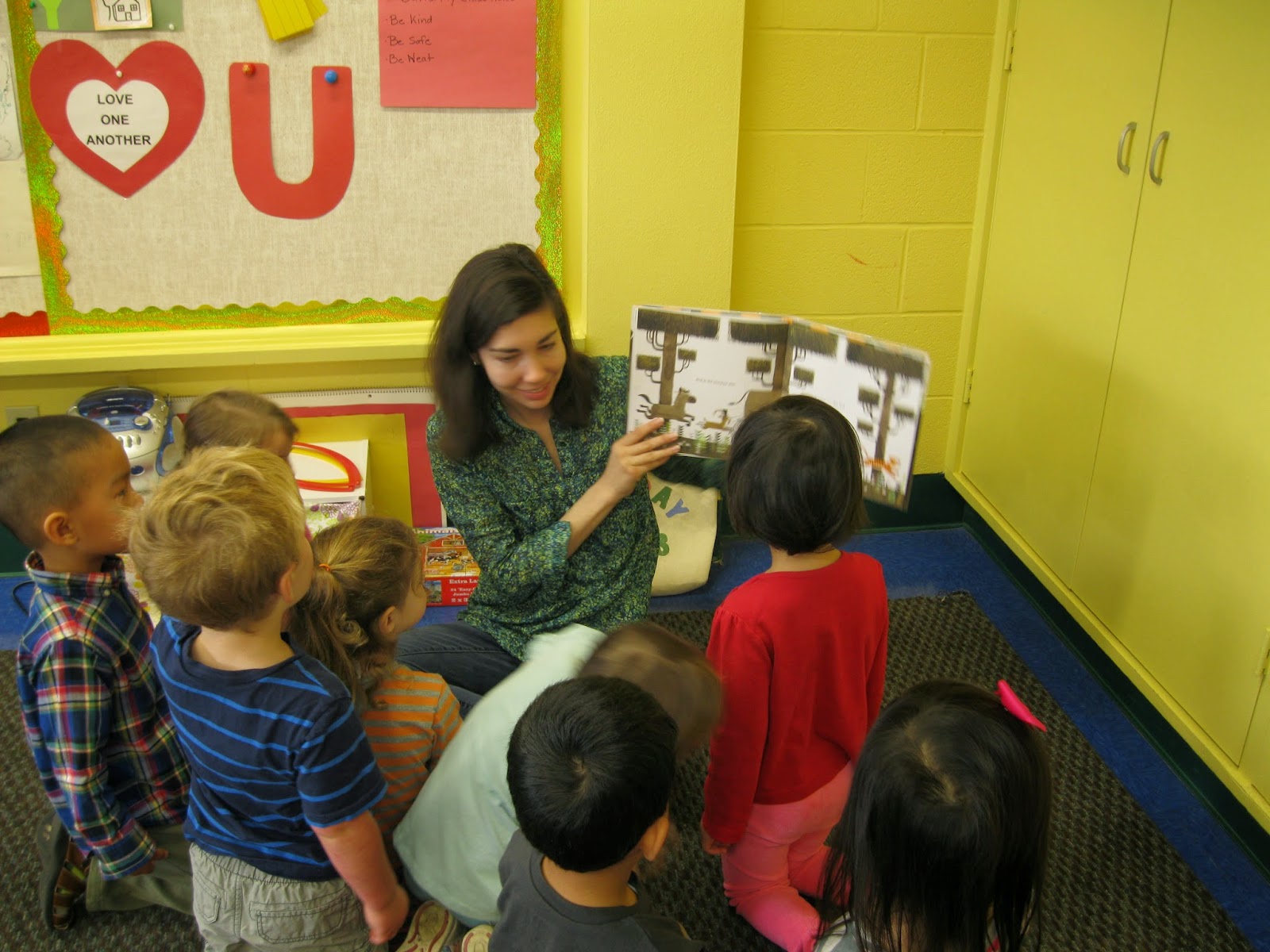
We have been enjoying having a few parents share some stories with the children. Joseph's mom read books in English and Chinese. Joseph's older brother, a former Bunny Rabbit, joined us, too.
Sidney helped her mom choose books that she thought her friends would like to hear. Reading time is very casual - the size of the group varies, but the enthusiasm is high.Thanks, parents. We look forward to more visits!
Wednesday, March 5, 2014
Monday, February 17, 2014
Love One Another
Exchanging valentines is a sweet simple expression of love. The Bunnies love preparing little Valentines at home for their friends and bringing them to school. In class, each Bunny got to pass out his or her valentines by placing one in each bag around the table. Exchanging valentines isn't as easy as it sounds. It is an excellent and motivating way to practice one-to-one correspondence.
We had darling store-bought cards, cards lovingly made at home and cards with bible verses reminding us of God's love. Each Bunny was very excited to take them home. Can't you remember that fun feeling of taking home a bag of valentines to go through and read?! We hope the Bunnies always feel loved!
Thursday, February 6, 2014
Valentine Literacy
Valentine's Day is a fun day for the children at school. We don't focus on the commercial aspects of Valentine's Day, but rather on God's love for us and our love for our families and each other.
Literacy plays right in to this holiday so easily. In this particular class of Bunnies, not many are interested in writing their names. They certainly recognize their names and even recognize their friends' names, but they are not much for grabbing a marker and writing their names themselves. No problem! There are many other ways to practice names.
We used our Valentine bags as an opportunity to practice names. Each child got a strip of paper and access to a name card with their name already properly spelled out with a photo to match. Some used their name card to help them, and some didn't need it. In the red tray are alphabet stamps. Each child stamped their name and then glued it onto their bag.
This kind of activity gives teachers a fantastic opportunity to assess children's levels of competency with name and letter recognition in a non-traditional way. We discovered that most children could spell their names and use right to left progression properly. Yay Bunnies!
Literacy plays right in to this holiday so easily. In this particular class of Bunnies, not many are interested in writing their names. They certainly recognize their names and even recognize their friends' names, but they are not much for grabbing a marker and writing their names themselves. No problem! There are many other ways to practice names.
We used our Valentine bags as an opportunity to practice names. Each child got a strip of paper and access to a name card with their name already properly spelled out with a photo to match. Some used their name card to help them, and some didn't need it. In the red tray are alphabet stamps. Each child stamped their name and then glued it onto their bag.
This kind of activity gives teachers a fantastic opportunity to assess children's levels of competency with name and letter recognition in a non-traditional way. We discovered that most children could spell their names and use right to left progression properly. Yay Bunnies!
Wednesday, February 5, 2014
Simple Joys of Nature
Mrs. Boone, our outdoor educator, brought huge piles of leaves for the children to play in, and the joy on their faces was so apparent. Nature provides us with simple joys if we will only take the time to notice.
Subscribe to:
Posts (Atom)